Edina High School students push for stricter gun storage rules on school grounds, but lawmakers remain divided.
By Margarita Rosales Alarcon, Venture Academy, Shrunali Dhotre, Wayzata High School, Max Freeman, Rosemount High School and Amal Bedru, Math and Science Academy
Anushka Narielwala, Alvi Buzar Barua and Aditi Jha believe they have an idea that could help prevent the next school shooting.
As members of the Legislative Action Committee, LAC, for the Edina School Board, high school students are urging the Minnesota Legislature to make it a crime to knowingly possess a gun, or even a replica of a gun on school premises without proper storage.
Their proposal would require guns brought onto school grounds to be secured in a safe storage container.
Currently, firearms are largely prohibited on school grounds in Minnesota. However, the law allows certain exceptions for people with permits who store firearms in their vehicles.
Jha, a student at Edina High School, said gun owners should have the responsibility to store firearms safely.
“You should be cognizant of the fact that you essentially have a murder weapon, whether you like it or not,” she said.
State Rep. Julie Greene, a Democrat, whose district includes Edina High School, has worked with the LAC to propose a bill that would make failure to properly store a gun on school grounds considered as a felony, punishable by up to five years in prison and/or a $10,000 fine.
Michigan, Connecticut and Colorado are among states that have enacted safe storage laws for firearms left unattended on school grounds.
But the Minnesota Legislature remains divided on gun safety proposals, with Republicans generally opposing new restrictions.
While presenting their proposal, students said they felt lawmakers were not paying attention to them.
“I saw several of them on their phones during testimony, so I don’t think they’re really taking it seriously,” Jha said after the group presented its proposal to the House Education Policy Committee.
“These lawmakers love to say we value our youth,” she said. “But they don’t listen.”
Events at the Capitol have highlighted the impact of gun violence on students.
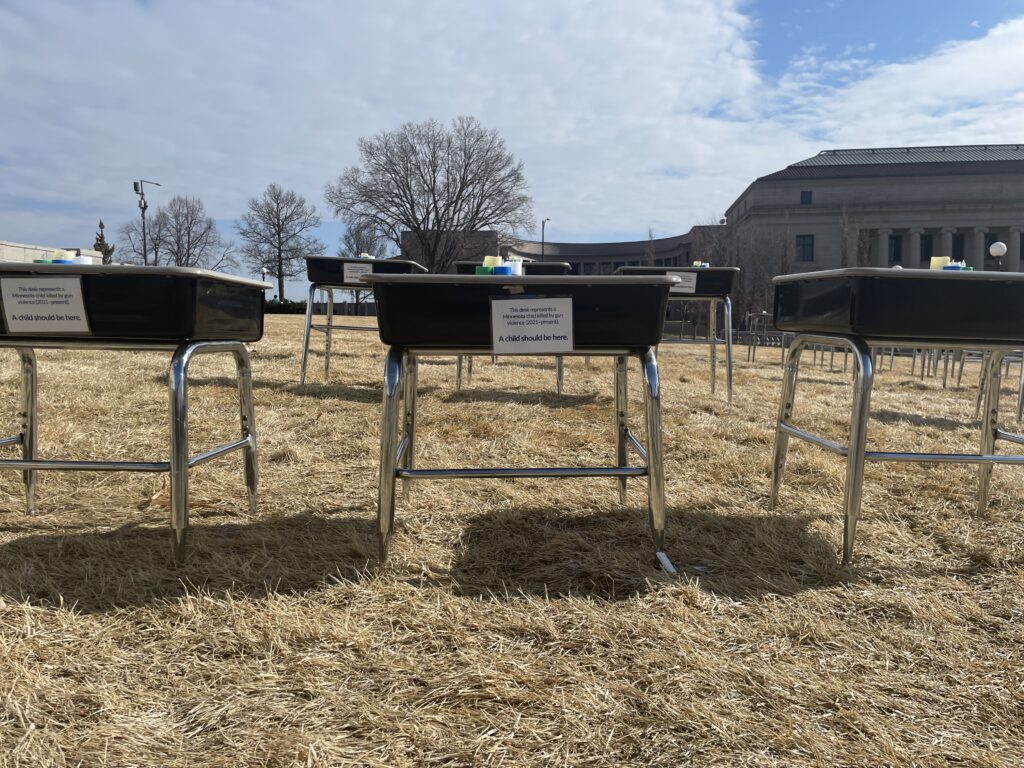
Empty desks were placed on the Capitol lawn to represent more than 200 Minnesota school children killed by gun violence since 2021. Inside the Capitol building, two desks honor 8-year-old Fletcher Merkel and 10-year-old Harper Moyski, who were killed in the Annunciation school shooting in Minneapolis last year.
“Gun violence in school, especially for us and our generation, feels almost like normalized because of how common it is,” Barau said.
“A multitude of states have safe storage gun laws, and we’ve seen gun theft and violence go down,” Jha said. “Why doesn’t Minnesota have a safe storage law?”
Part of the reason why is strong opposition from gun rights advocates, including members of the Minnesota Gun Owners Caucus. The Minnesota Gun Owners Caucus, a prominent gun rights group in the state, opposes new gun restrictions, “Defending the second amendment in the legislature and in the courts.” Multiple messages left with the organization were not returned.
Messages left with Rep. Paul Novotny, a Republican from Elk River and chair of the House Judiciary and Public Safety Committee, were also not returned. Novotny stands on many issues regarding Minnesotans, one of them being, “Pro 2nd amendment and against RED FLAG laws. Red flags are unconstitutional” Any gun-related legislation must pass through that committee before advancing to the full House.
Rep. Tabke, a Democrat from Shakopee, has introduced separate gun reform legislation that would ban high-capacity magazines, magazines that hold more than 100 rounds.
Tabke authored a bill that would ban high-capacity magazines, which are defined as magazines that hold more than 10 rounds.
According to a Lumaris Research poll, 69% of Minnesotans surveyed support an assault weapons ban. High-capacity magazines are commonly used in tandem with assault-style rifles.
However, the Minnesota House is evenly split between Republicans and Democrats, making it difficult for gun legislation to advance.
“Nothing’s going to pass,” Tabke said, citing Republican opposition.
“They don’t think it’s unreasonable,” he said. “They just refuse to vote for it out of political expediency.”
At the same time, many other Minnesotans remain strongly opposed to new gun restrictions.
“[A] portion of Minnesotans do care about this, and I care that they care. And so that’s been really good for me to hear from them,” Tabke said.
He said he has received more than “11,000 emails from folks who don’t want gun control.”
Because of his strong stance on gun policy, Tabke said he has also received threats. “I’ve gotten just so many death threats and so many people who specifically want to say how they want to take care of me,” he said.
Tabke wants to make it clear that he supports gun ownership.
“Owning guns, I am just absolutely not in opposition to that [because] of the Constitution,” Tabke said.
He believes it doesn’t give anyone the right to do whatever they want or kill whoever they want. “I just don’t think that that’s what the Constitution intended,” he said.
Without bipartisan support, gun reform proposals are unlikely to move forward.
Tabke said passing meaningful gun legislation will require “someone who has an immense amount of political courage” to bring lawmakers together.
The disagreement among lawmakers reflects the deeply polarized political climate surrounding gun policy.
But while finding common ground is difficult, it isn’t impossible. Students like Anushka and her friends said they are taking small steps and will continue to push for change.
This story was produced as part of ThreeSixty Journalism’s 2026 Capitol Reporting Workshop for Minnesota youth, with financial support from the Saint Paul & Minnesota Foundation. Margarita Rosales, Shrunali Dhotre, Max Freeman and Amal Bedru worked with MinnPost senior state government reporter Matthew Blake to complete their story.
