
By Janya Dieringer, Johnson Senior High School
Minneapolis has the opportunity to rebuild a community it helped destroy.
If the city doesn’t support the Roof Depot project in the East Phillips neighborhood, it will once again show that the pain of this community does not matter to them. Supporting the project could spark real change in East Phillips and set an example for other community-led urban farm projects across the city.
Beneath the Roof Depot building sits four feet of arsenic-contaminated soil. The building was once a warehouse and next to it was a chemical plant that produced arsenic-based pesticides.
The neighborhood has faced environmental racism for decades. Years of pollution from industrial plants and highways has crept into the lungs of the community, raising rates of asthma and childhood lead exposure, according to reporting from MinnPost. In 2016, the city bought the building intending to demolish it, a move that could have released more pollutants into the air.
The word “Imagine” is weaved into a fence that stands outside the Roof Depot Building in Minneapolis, Minnesota. The East Phillips Neighborhood Institute has been attempting to buy the building from the city of Minneapolis since 2014. Photo by Carina Dieringer, October 18, 2025
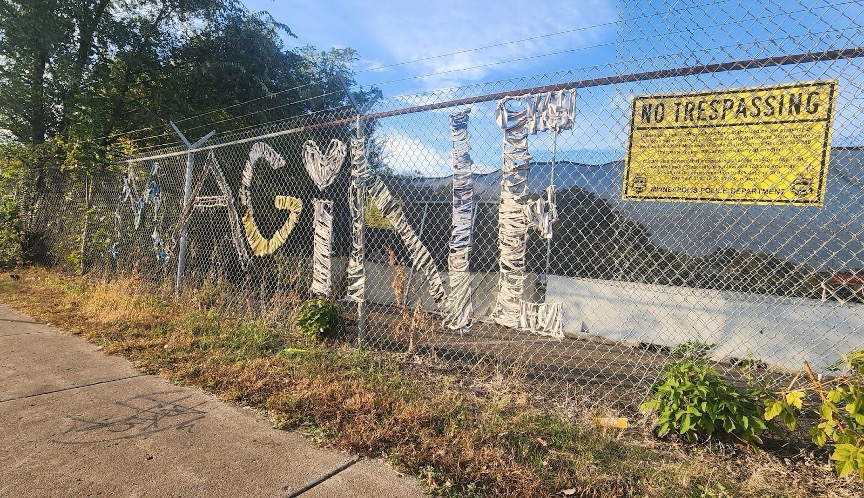
The East Phillips Neighborhood Institute (EPNI) has spent more than a decade trying to buy the building to turn it into an indoor urban farm and community center. But, both the state and the city have repeatedly failed to support their efforts. This reflects a larger problem: funding community-led urban farms.
Urban farms matter to local communities. They provide fresh food to residents who struggle to access it, create green and open spaces, and generate local jobs. As the climate crisis worsens, their role becomes even more critical.
“Climate change makes it harder to grow food, and big ag is failing to increase their crop production,” said Marcos Giossi, Market Garden Farm Manager at Urban Roots, an urban farm located on the east side of Saint Paul, where I’ve worked since the summer of 2024. “The result is food insecurity, when fresh, nourishing food becomes less available and more expensive,” Giossi said.

Transforming polluted land into farmland is possible. At Urban Roots, our largest farm site, Rivoli Bluffs, sits on land that was once a neighborhood dump.
“It was basically a neighborhood dump,” Giossi said, “it went through a restoration process… so the food we are growing is far away from the garbage that is below.” But unlike Rivoli, the Roof Depot site is profitable to the city, making it harder for the community to reclaim it.
Rivoli sits near an airport, where building is restricted. The Roof Depot site, however, is developable land. The city originally planned to build a new Public Works facility there.
Despite this, EPNI and the East Phillips community have never stopped fighting. The biggest obstacle for the Roof Depot project, like many other urban farms, has always been funding. After years of pushback, the city dropped its Public Works plan, and made several deals to sell the building to EPNI, tied to local and state funding.
Reporting from Sahan Journal indicates that state lawmakers promised $12.2 million, but only $6.5 million was delivered, even after EPNI raised the required match for the remaining $5.7 million.

After that devastating news, EPNI then lowered its offer to buy the building for $10.2 million. The city rejected it. Officials have given EPNI until Nov. 15 to purchase the property at the full $11.4 million. After that, they’ll consider other buyers.
I have seen urban farms like Urban Roots can do. From providing youth jobs and access to fresh produce to donating more than 6,000 pounds of food to the community this year, Urban Roots has changed my life and many others.
The money that farms (or potential farms) like EPNI’s Roof Depot site are asking for is a tiny fraction of the state budget. To put things into perspective Sahan Journal reports that the Minnesota legislature passed bills to finish a $66 billion two-year spending plan. Included in that was a $700 million capital improvement bill, but local funding wasn’t included. Out of the capital improvements the $5.7 million would make up only 0.081% and of the whole budget only 0.009%.
Despite overwhelming community support for this project and proof that projects like this do improve local communities, the city has made it extremely difficult for EPNI to buy the land.
As the November deadline and Minneapolis mayoral election nears, it’s important that we continue to support and vote for candidates that support the Roof Depot project and similar community efforts.
We need to keep fighting for our neighborhoods. If we don’t, who will?

Janya worked with Minnesota Reformer Reporter Madi McVan and Racket Editor Keith Harris to complete her story. This story was produced as part of ThreeSixty Journalism’s 2025 Opinion and Commentary Workshop for youth, in partnership with Sahan Journal and MinnPost.
