The Oscarbate Film Collective just wants to have fun
By Anais Froberg-Martinez
While my sister was on a trip to New York in 2025 to see the rerun of Hamilton, I sat in my room, slightly annoyed at the fact that the Chantal Akerman exhibit was just 0.9 miles away from the play at the Richard Rodgers Theatre. I was just getting into arthouse films and one of the first directors I got interested in was Chantal Akerman. By passing her films off as an odd video on the internet, I could hear my friends’ casual opinions on her work. I found solace in an internet community which joked about her work. I dreamed of going to her screening, even if it was all the way in New York.
However, when I went to my first screening of an arthouse film, the environment was disappointingly stiff. It was at a museum about half an hour away from my house. The doors shut at exactly 7pm, and no one dared to get up or use the bathroom. They all stayed silent until the end, when they clapped as the credits rolled in. I split the movie into thirds to time how often I’d rotate my legs, feeling like even that would disturb the peace.
I didn’t know what to expect when I asked ThreeSixty to get tickets for the Davis Theater to see Revelations of Divine Love, directed by Caroline Golum. I came in with little knowledge about the movie, only that it was vaguely based on the life of Julian of Norwich, a secluded woman in the 14th century who claimed to see visions of God. Caroline Golum had recently been interviewed by the New York Times, explaining the obsession and passion interwoven in the film, which originated in her small Brooklyn apartment. Something the article did not touch on was how the film made its way to the Davis from independent theaters in New York. I reached out to Oscarbate Film Collective, which selected the movie for programming.
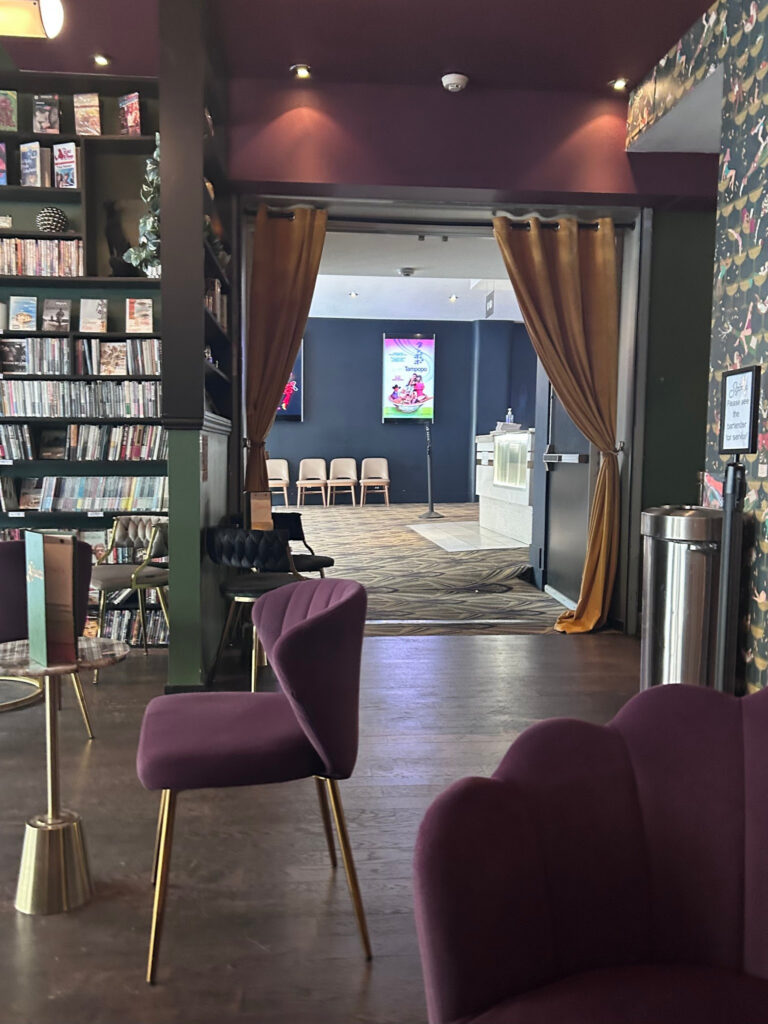
In the company of dozens of analog film DVDs, both rare and classic, I waited for John Dickson of Oscarbate to arrive on May 16th. I noticed that the Davis had dozens of analog films available for rental in the small bar and lounge attached to the theater. Dickson explained that he got into film programming after being a critic for several years after film school. “It just felt a little industrial… like military school vibe,” Dickson said, referring to the way that film is taught in an institutional setting, where simple methods of extracting plots and specific shots from the masters of cinema restraints students. Dickson references French filmmaker Robert Bresson: “He always talked about the image, he never makes things for a story first […] everything has to fit into the image.”
It’s clear that Dickson’s approach towards movies goes beyond specific shooting or writing techniques: he emphasizes aspects of psychology, sociology, and philosophy. Dickson also mentions the horror genre, and how horror movies increasingly tend towards a deeper meaning rather than horror for horror’s sake. This phenomena is part of a wider problem in art of pieces being valued for an intrinsic meaning rather than the piece itself, described in the influential essay “Against Interpretation” by Susan Sontag.
Dickson also mentions that “low-budget films” like Revelations of Divine Love are often expected to explore themes that feel feasible within that budget. Golem’s historical drama, which requires a lot of makeshift props, clothing, and all other accuracies that are expected in period dramas. However, Dickson found Golem’s film extraordinary in the fact that it doesn’t limit itself, and devises creative ways to keep the viewer engaged, like miniature hand-crafted models of aerial shots of the town of Norwich. By letting go of the expected realism, Golem is also able to explore the original, colorful medieval text – Revelations of Divine Love by Julian of Norwich herself.
Even sitting in the lounge area, I realized how much of the physicality of a film community I ran to emulate through apps like Letterboxd. “It’s like Letterboxd really is just this kind of digital proxy in which to substitute for lack of people [in] theaters because it simulates this.” However, a downside to the online film community is rushing to understand what a film means before you even watch it. Dickson has noticed this pattern as a response to sitting with the feeling of the unknown after his series such as “Trust Fall,” a monthly series where an unknown movie is played at the Davis.
At first, I was embarrassed that I was a high school student who wasn’t very well-versed in films, but Dickson reassured me that his curations are not meant solely for the elite fans of film. To me, his series translate deeper concepts of the purpose of cinema into series that explore emotions everyone can feel. Towards the end of the interview, I asked Dickson why he called his programming duo a “Collective,” and he explained that a large part was because of the name Oscarbate, which was subject to endless running jokes in the industry and reduced their image to immature and childish. However, a part of Dickson owns it– he sticks to the name Oscarbate to resist the self-righteous expectation among filmmakers. He says: “I would honestly rather be taken as an idiot and then people could just see the stuff and not worry about that.”
This story is part of a series produced from the ThreeSixty Youth Leadership Board’s annual journalism trip.
