By Lani Ngonethong, St. Paul Academy and Summit School, Muhammad Memon, Wayzata High School, Maheideri Belay, Woodbury High School and Ola Osibodu, Champlin Park High School
This story was published in Sahan Journal.
Lexi Mongeri woke up Jan. 25 to Immigration and Customs Enforcement (ICE) agents outside her Champlin, Minnesota apartment.
She watched from her window as they handcuffed her uncle and took him away. Her mother decided no one in the family would leave their home that day. Mongeri’s life changed overnight.
“I stepped up as a big cousin to watch my little cousin, who had to see her father be taken,” Monegri said. “It was just really hard to keep her positive and motivated to go to school.”
After the arrest, Mongeri said her grades dropped.
“I just felt lost,” she said. “I felt like I had to do this on my own, even when I had people beside me.”
She now carries her passport or birth certificate wherever she goes.
Mongeri’s experience is part of a sweeping federal immigration operation that has reshaped daily life across the Twin Cities. Beginning in December 2025, the Trump administration deployed more than 3,000 federal immigration agents to Minnesota in what officials call “Operation Metro Surge.”
The campaign drew intense opposition and protests after violent confrontations between civilians and federal agents. Several people were shot during incidents connected to the operation. Two of the shootings were fatal, killing Renee Nicole Good and Alex Pretti.
At the height of Operation Metro Surge in January, Minneapolis Public Schools closed for two days and St. Paul Public Schools closed three to prepare for virtual learning options. Some schools saw attendance rates drop as much as 60% as families chose to stay home.
One of those families was N.’s, a Saint Paul Public Schools student, whose parents came to the United States as Karen refugees. N. asked to remain anonymous because she fears drawing attention to her family amid increased ICE violence.
“Education is number one for my mom,” N. said. “So, for her to tell us that we have to stop going to school, there has to be a really big problem.”
N., who participates in several school activities, said she had to pause schoolwork and group projects, leaving them to classmates who were able to attend class in person. She said many other students stayed home as well.
The fear spread into other parts of her life. N. said her church sent notices to families about how to stay safe.
Her concerns grew after the Department of Homeland Security, DHS, terminated temporary protected status for Karen refugees at the end of January.
“It was straining to see that everybody around me was scared and tired, to a point where we had to check in with other members of the Karen community,” she said. “We came as refugees. This was supposed to be a safe place for us.”
The Trump administration also revoked federal protections that previously designated certain places as “sensitive locations” where immigration enforcement was limited. These included hospitals, places of worship, and schools.
The change was felt at Roosevelt High School on Jan. 7, when armed U.S. Border Patrol officers entered school property, tackled students and arrested two staff members.
In response to the end of protections for “sensitive locations”, state Rep. Sydney Jordan, DFL- Minneapolis, who chairs the Education Policy Committee, introduced HF 3435. The bill would prohibit public and charter schools from consenting to immigration enforcement on school property without a valid judicial warrant.
“It was clear that schools across the state of Minnesota needed this,” Jordan said. “Even in greater Minnesota and the Willmar School District, they had thousands of students miss school one day because they were worried about ICE enforcement.”
The bill did not advance from committee, where committee members split 7-7, along party lines.
“I am going to keep working on this bill because it is so important to Minnesota schools and students,” Jordan said. “I hope that one of my Republican colleagues will join me.”
In the Minnesota Senate, lawmakers introduced bill SF 3611, the companion bill to HF 3435. It passed in committee in a unanimous vote.
Sen. Jim Abeler, R- Anoka, who has been outspoken within the Republican caucus, and criticized ICE’s actions in Minnesota, is on the Education Policy Committee. He voted in favor of SF 3611.
In early February, Abeler also drafted and sent a letter to former DHS Secretary Kristi Noem and border czar Tom Homan, calling for changes in federal enforcement tactics and urging agents not to target schools and children.
“From the left, [responses] were all positive,” Abeler said of the responses he received from colleagues. “There was a lot of silence from the right and then a few snide comments.”
“If they got a green card, leave them alone, same if you’re a refugee,” he said. “There were so many citizens that got picked up. What are we doing?”
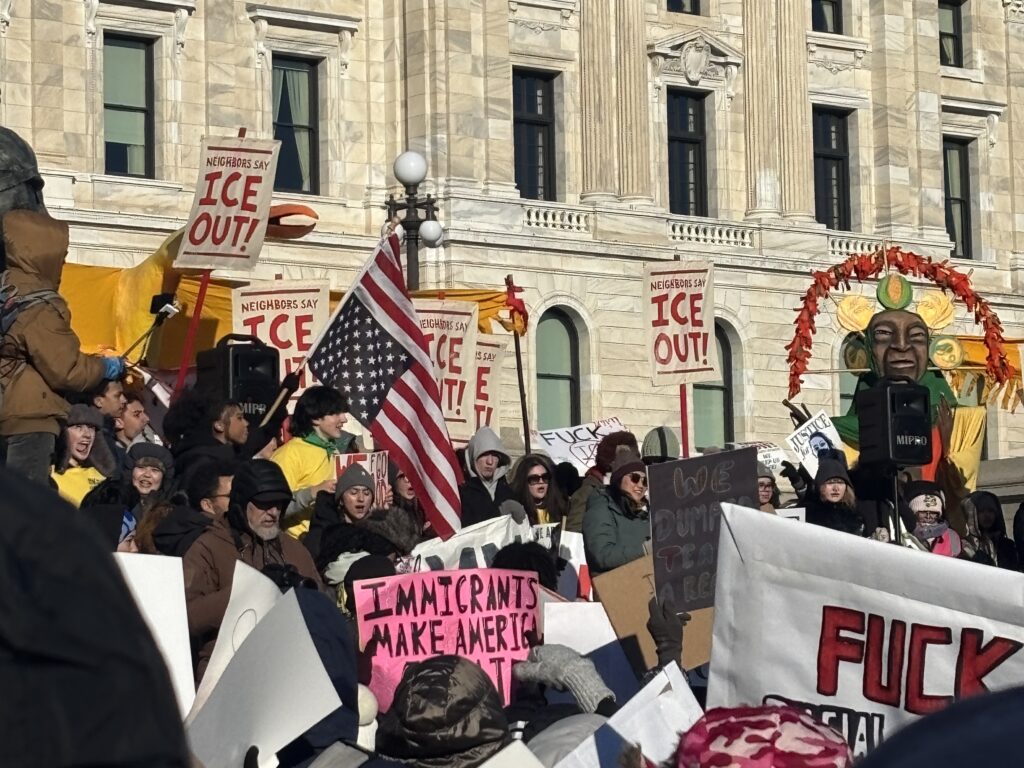
While lawmakers debate policy at the Capitol, Minnesota students have been among the loudest voices protesting the immigration crackdown, chanting “ICE OUT.”

Youth across the Twin Cities have staged walkouts in protest, including protests at Roosevelt High School. St. Paul Public Schools students organized a district-wide march to the Minnesota State Capitol on Jan. 14.
Mongeri was among the students who participated in walkouts at her school. She said she marched to raise awareness of the stories of others and with one reminder to share.
“This isn’t something we should even be going through in the [21st] century,” Mongeri said. “Why are we going through discrimination and racism like this? America is supposed to be the land of freedom.”
This story was produced as part of ThreeSixty Journalism’s 2026 Capitol Reporting Workshopfor Minnesota youth, with financial support from the Saint Paul & Minnesota Foundation. Lani Ngonethong, Muhammad Memon, Maheideri Belay, and Ola Osibodu worked with Sahan Journal reporter Shubhanjana Das and audience growth manager Samantha HoangLong and MPR producer Ngoc Bui to complete their story.
